
Orange Oil for Termites

Do orange oil termite treatments work? Is it a safe alternative to fumigation?

One of the most common questions our customers ask is about orange oil treatment for termites. Orange oil treatment has been heavily marketed by a few companies for the last 30 years or so.

Some of the claims made have stretched the effectiveness of the orange oil product.

In the United States alone, termites cause over $5 billion in damage every year.

Suspect you have termites in the Bay Area? Contact us for an inspection and consultation.

Facts about Orange Oil

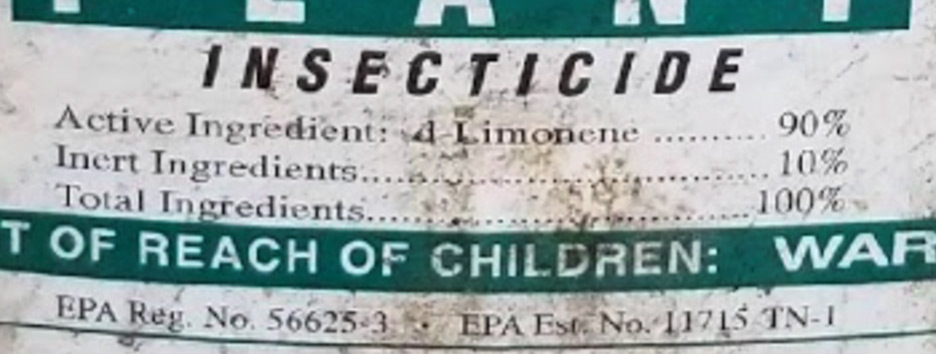
1. Orange oil is not a new product. Power Plant, the 1st Orange oil product for termite control, was registered in 1997. The active ingredient in Orange oil is d-limonene, which you can see listed on this old bottle of Power Plant.
2. Not exclusive-use. Any pest control company can apply orange oil. It is not a proprietary product or treatment method.

3. Not a whole-house treatment. It is only used for localized spot treatments. It is not considered to be whole-house treatment and will not eradicate termites in hidden or inaccessible areas.

4. Kills on contact and repels termites from treated areas – not a positive quality. This may sound like a good way to get rid of termites, but this is actually NOT the desired quality. Orange oil “melts” or dissolves the chitinaceous exoskeleton and cell membranes of termites, causing lethal loss of proteins and water.

While it will kill the termites it reaches, it will repel other termites colonized outside the treated area so they will avoid it and continue to thrive elsewhere. Termites are almost always hidden, deep in structures, making Orange oil one of the least effective treatments, especially for subterranean termites.

For drywood termite treatment, it can also be limiting since the galleries these termites live in can be deep in the structure and challenging to find/access. For widespread infestations, orange oil (and other localized treatments) should not be used as an alternative to fumigation.

5. Low residual effectiveness. Orange Oil degrades by 93% in three weeks, offering no long-term protection. Another study showed the treatment dissipated within one week (Raina et al. 2007).

6. Strong citrus aroma. The smell lingers in the home for 4 to 7 days and can be overpowering and irritating. It is listed as being an irritant to eyes and skin. Consuming it would cause vomiting.

7. Not Green-Rated. Orange oil is NOT a Green-Rated product.

8. Toxicity & Flammability. The d-limonene in Orange oil is derived from the peels of oranges, extracted during the process of pressing the peel.

While this treatment made from orange peels is low in toxicity, other termite treatment products have even lower toxicity. Chemically defined as a terpene, it is classified as moderately flammable / combustible by the NFPA (National Fire Protection Association), rated a 2 on their flammability scale, with a flash point of around 46 – 49°C (115 – 120°F).

Safety Data Sheet Comparisons

Compare the SDS of XT-2000™ (the Orange oil / d-limonene product registered for use in California) and the SDS of Termidor, the product we (and most termite control companies) use for spot treatments.

Orange oil is also sold as a cleaning agent and functions as an effective solvent. Because of its solvent properties, it may damage paint when used on painted surfaces.
Termite Treatment Trends

Franz Termite Control has been in business since 1971. In the 50+ years we’ve been in business several methods of termite eradication have come and gone.

Some examples of this are the “Electro-gun”, the liquid nitrogen freezing method, and microwaving. Freezing and microwaving were heavily promoted drywood termite local treatment methods that didn’t have the effectiveness needed to control drywood termites and both were discontinued after a few years.

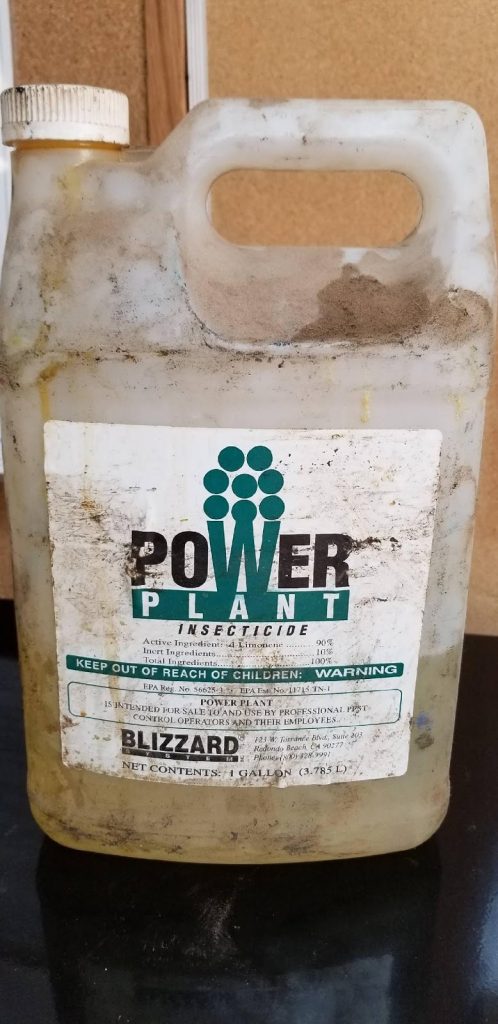
Power plant insecticide bottle (now known as orange oil)

Power Plant, the first Orange oil product for termite control, was registered in 1997.
We had used this product when it initially came out in 1998, but had enough call-backs that we discontinued using it. In addition to complaints of continued termite activity many of the complaints included the strong odor and fumes.

Orange oil is “old-fashioned” in the way it kills termites. It performs the way that older pesticides used to perform; it will kill the termites on contact and repel other termites from the treated area, causing the termites to move to another part of your house.

Here you can see a jug of PowerPlant orange oil that has been sitting in our storage locker for about 50 years when we last used it.

Modern Spot Treatments

Modern, new-generation products are designed so that they do not immediately kill or repel termites. Rather they allow the termites to come into contact with the treated area and transfer the product back to the colony. This has a much higher chance of eradicating an entire colony and not moving them to another area of your house.

For spot treatments, we currently use Termidor Foam Termiticide, an injectable foam that is administered on infested wood after drywood termites have been detected. In some cases, we also use Bora-Care® to treat termites and protect affected wood from future infestations.

Orange Oil Effectiveness

When a wooden mockup of a wall void was used as a test platform in a 2007 study, a higher concentration of orange oil (10 ppm) resulted in only 15% mortality of the termites.

The researchers believe the wet wood used in the test absorbed the orange oil, reducing its effectiveness as a fumigant. This suggests that the wood’s ability to absorb orange oil may actually limit its fumigant action. 

California’s modern equivalent of PowerPlant is XT-2000 orange oil.

One measure of the effectiveness of any termite treatment method or product is to see how many companies are using it.

Orange oil products can be used by any licensed pest control company and have been for years. If it was as effective as some advertisements may lead people to believe we (termite control companies) would all be using it. While orange oil can kill termites, there are other products that do a better job of local treatment.

The main thing to consider is that orange oil treatment is a local treatment that, like all local treatments, will only be effective in and adjacent to the treated areas. The method of application is the same as our normal local treatment process and involves injecting into the infested areas of a structure.

While local treatment is always an option it may often be more of method of “control” of termites as opposed to eradication – something that is guaranteed when it comes to termite fumigation for drywood termites.

References

Raina A., Bland J., Doolittle M., Lax A., Boopathy R., and Folkins M. (2007). “Effect of Orange Oil Extract on the Formosan Subterranean Termite.” Journal of Economic Entomology, 100(3), 880–885. Available via PubMed: https://pubmed.ncbi.nlm.nih.gov/17598551/ 

Mashek B. and Quarles W. (2008). “Orange Oil for Drywood Termites: Magic or Marketing Madness?” The IPM Practitioner, Vol. 30, No. 1/2, pp. 1–9. Bio-Integral Resource Center (BIRC). Available online: https://www.birc.org/JanFeb2008.pdf

Lewis, V. R., & Forschler, B. T. (2014). “Management of Drywood Termites: Past Practices, Present Situation and Future Prospects.” In Urban Insect Pests: Sustainable Management Strategies (ed. P. Dhang). CAB International. Available via ResearchGate: https://www.researchgate.net/publication/287304720_Management_of_drywood_termites_Past_practices_present_situation_and_future_prospects

If you suspect a termite infestation, please contact us for a termite inspection by our certified and licensed professional inspectors.